
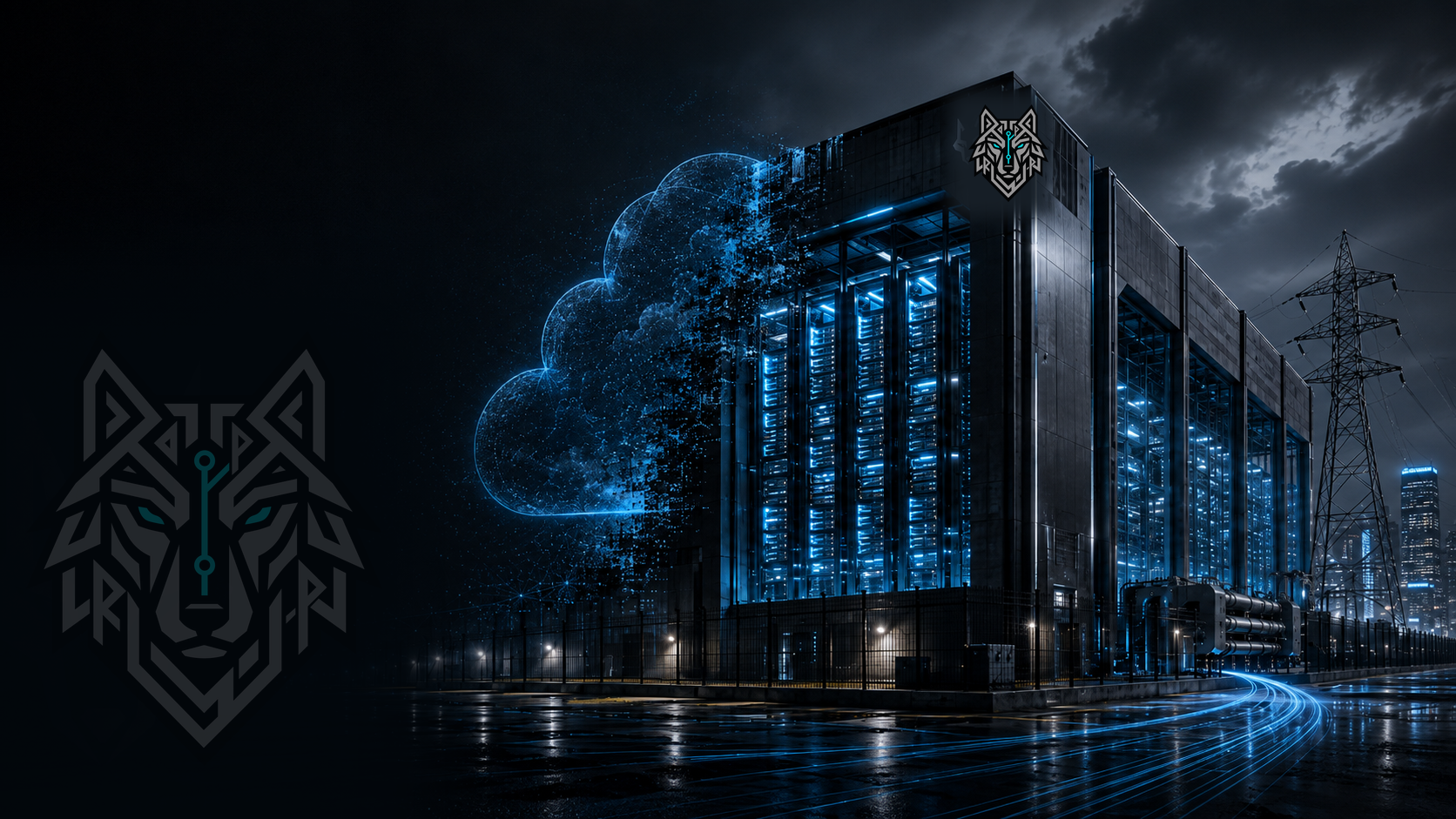
AI didn’t invent the data center. It made the infrastructure impossible to ignore.
For more than twenty years, people have been told that their data lives in “the cloud.”
- Photos went to the cloud.
- Email went to the cloud.
- Business software went to the cloud.
- Movies, music, backups, databases, websites, financial systems, games, social networks, and entire corporate IT departments went to the cloud.
It sounded clean. Weightless. Almost immaterial.
Then artificial intelligence became mainstream, data-center construction accelerated, electrical demand started appearing in headlines, and suddenly people discovered something remarkable:
The cloud has a power cord.
It always did.
The current debate around AI data centers contains legitimate concerns about energy generation, electrical infrastructure, cooling, water use, land, cost allocation, and local grid capacity.
Those questions deserve serious discussion.
But much of the broader outrage rests on a fundamental misunderstanding of what digital infrastructure actually is.
AI did not suddenly turn the Internet into a physical system.
The Internet was physical the entire time.
THE ABSTRACTION
“The cloud” is one of the most successful abstractions ever sold to the public.
It allowed people to stop thinking about the machines underneath their digital lives.
- Save a photograph.
- Click a button.
- Stream a movie.
- Send a message.
- Run an application.
The machinery disappeared from view.
But it never disappeared from reality.
Cloud computing is ultimately the remote use of computing resources: processors, memory, storage, networking, databases, applications, and services running on hardware that someone else owns and operates.
In simpler terms:
The cloud is somebody else’s computer.
At modern scale, it is more accurate to say:
The cloud is thousands upon thousands of somebody else’s computers connected together inside enormous facilities.
Those facilities contain servers, storage arrays, networking equipment, accelerators, cooling equipment, power-distribution systems, batteries, generators, transformers, pumps, fiber connections, security infrastructure, and everything else required to keep computation operating continuously.
There is nothing virtual about the machinery.
Only your interaction with it is abstracted.
WE DIDN’T REMOVE THE SERVERS
The shift toward cloud computing was never the elimination of infrastructure.
It was the consolidation of infrastructure.
A company that once maintained servers inside its own building might now use Microsoft Azure, Amazon Web Services, Google Cloud, or another provider.
- A local mail server became Microsoft 365 or Gmail.
- A company file server became SharePoint, OneDrive, Dropbox, or another cloud-storage platform.
- Physical media became Netflix and Spotify.
- Locally installed software became SaaS.
Personal photo collections became massive online libraries synchronized across devices.
The servers did not disappear.
We moved them.
Instead of every organization maintaining its own collection of machines, enormous providers began operating computing infrastructure at scales individual organizations could rarely achieve.
That created significant advantages.
- Shared infrastructure.
- Redundancy.
- Rapid scaling.
- Centralized maintenance.
- Better utilization.
- Global access.
- Lower barriers to deploying software.
The modern digital economy was built around this transition.
And almost everyone accepted it.
Then AI arrived.
AI DID NOT INVENT THE DATA CENTER
Data centers existed long before generative AI.
The modern Internet could not operate without them.
Neither could:
- cloud storage
- streaming media
- online banking
- e-commerce
- social media
- enterprise software
- web hosting
- multiplayer gaming
- search engines
- video conferencing
- software distribution
- content delivery networks
- digital advertising
- large-scale scientific computing
Artificial intelligence is not replacing an infrastructure-free Internet with an infrastructure-heavy one.
AI is adding an extremely compute-intensive workload to an infrastructure-heavy system that already existed.
That distinction matters.
Because without it, the discussion quickly degenerates into:
AI uses electricity.
Yes.
It is computation.
That is what computation does.
The useful question is not whether it consumes resources.
The useful question is:
How efficiently can we provide those resources, and what infrastructure needs to exist to support them?
That is a very different conversation.
THE LOAD IS REAL
Rejecting bad arguments does not require pretending AI has no infrastructure cost.
It does.
Modern AI systems can require significant processing capacity both during training and during operation.
High-performance GPUs and specialized accelerators can create extremely dense electrical loads.
As deployment increases, data-center electricity demand is expected to increase with it.
Berkeley Lab’s 2026 analysis estimates that U.S. data centers could account for roughly 11.8% of U.S. electricity consumption by 2030 under its reference scenario, with substantial variation across modeled outcomes.
The International Energy Agency projects global data-center electricity consumption approaching 945 terawatt-hours by 2030 in its base case.
Those are not trivial numbers.
They represent a genuine infrastructure challenge.
But identifying the challenge correctly matters.
A rapidly growing electricity load does not automatically mean:
Stop the technology creating the demand.
It means we need to determine how to supply that demand intelligently.
- Generation.
- Transmission.
- Distribution.
- Storage.
- Cooling.
- Efficiency.
- Location.
- Grid resilience.
Those are engineering and infrastructure problems.
And engineering problems are solved by engineering.
THIS IS WHAT TECHNOLOGICAL GROWTH LOOKS LIKE
Civilization repeatedly creates technologies that require supporting infrastructure.
Automobiles required roads, bridges, fuel distribution, traffic systems, repair networks, and parking.
Commercial aviation required airports, air-traffic infrastructure, fuel logistics, maintenance facilities, and enormous manufacturing systems.
Mass electrification required power plants, transmission networks, substations, distribution systems, transformers, and decades of expansion.
Telecommunications required towers, cables, switching systems, fiber networks, satellites, and undersea cables.
Nobody should be surprised that widespread artificial intelligence requires infrastructure too.
Technological capability and infrastructure grow together.
The problem is not that AI requires resources.
The problem would be failing to build the systems necessary to provide those resources responsibly and efficiently.
THEN THERE IS WATER
Water has become one of the most repeated talking points surrounding AI.
Some of the concerns are legitimate.
Some data centers use substantial amounts of water for cooling.
But statements assigning a universal amount of water to an AI prompt are often presented with far more certainty than the underlying systems justify.
- Data centers are not identical.
- Cooling systems are not identical.
- Hardware is not identical.
- Climate is not identical.
- Electric grids are not identical.
- Workloads are not identical.
Berkeley Lab research has found that water consumption per computing workload can vary by more than four orders of magnitude depending on facility design, hardware efficiency, cooling technology, and electricity generation.
That is enormous variation.
So when someone announces that:
“An AI request uses exactly this much water.”
the obvious response should be:
- Where?
- On what hardware?
- At what utilization?
- Using what cooling system?
- Powered by what electrical generation?
- Under what environmental conditions?
Without those answers, an apparently precise number can create a profoundly misleading impression.
That does not mean water consumption should be ignored.
It means it should be measured correctly.
A data center built in a water-stressed region deserves different scrutiny from one using a highly efficient cooling system in a region with abundant resources.
Context matters.
Engineering matters.
Precision matters.
THE DEBATE WE SHOULD ACTUALLY BE HAVING
Once the noise is removed, the AI infrastructure debate becomes far more interesting.
Communities should be asking:
Who pays for new generation and transmission?
A multi-billion-dollar computing campus should not automatically become an excuse to transfer infrastructure costs onto ordinary ratepayers.
Can the local electrical system support the load?
If not, additional infrastructure needs to be built before demand overwhelms existing capacity.
Where should these facilities be located?
Climate, electrical generation, water availability, fiber connectivity, land, and surrounding infrastructure should all influence placement.
How should they be cooled?
Different environments require different solutions. Closed-loop systems, dry cooling, liquid cooling, immersion systems, and hybrid designs all present different tradeoffs.
Can computing demand become more flexible?
Some workloads may be shifted geographically or temporally when electrical systems are stressed.
Can data centers contribute generation instead of merely consuming it?
Large technology companies have the capital and demand certainty necessary to help support significant generation projects.
Where does nuclear power fit?
AI may ultimately accelerate investment in reliable high-density electrical generation, including advanced nuclear technologies.
How much more efficient can the hardware become?
Performance per watt matters enormously at this scale.
How much more efficient can AI itself become?
A model requiring half the computation to accomplish the same useful task changes the infrastructure equation immediately.
These are serious questions.
They deserve serious analysis.
EFFICIENCY MATTERS MORE THAN THE MEMES SUGGEST
Computing history also demonstrates why simply extrapolating demand without considering technological improvement can be misleading.
During the 2010s, data-center computing activity increased dramatically while total electricity consumption increased much more slowly.
Efficiency improvements absorbed a substantial portion of the growth.
- Processors improved.
- Virtualization improved utilization.
- Cooling improved.
- Power distribution improved.
- Facilities improved.
- Workload management improved.
That does not guarantee future demand will remain flat.
Current AI growth is substantial enough that total electrical consumption is expected to increase considerably.
But it demonstrates something important:
Demand is only half of the equation.
Efficiency determines how much infrastructure is required to satisfy it.
That mean:
- Better chips matter.
- Better models matter.
- Better cooling matters.
- Better scheduling matters.
- Better software matters.
- Better facilities matter.
A serious technology policy should encourage those improvements.
THE DIGITAL WORLD HAS ALWAYS BEEN INDUSTRIAL
Perhaps the most interesting thing about the AI data-center debate is what it reveals about our relationship with technology.
Modern software became so easy to use that we forgot what existed underneath it.
People began treating digital activity as though it occurred in another dimension.
But every digital interaction ultimately touches physical infrastructure.
- Somewhere, something computes.
- Somewhere, something stores.
- Somewhere, something routes.
- Somewhere, electricity is converted into computation.
- Somewhere, heat has to leave the machine.
The digital world has never been separate from the industrial world.
Software sits on steel.
Code runs on silicon.
Networks run through fiber.
Servers sit in racks.
Racks sit in buildings.
Buildings connect to electrical grids.
The abstraction was useful.
But confusing the abstraction with reality produces terrible arguments.
AI MADE THE INFRASTRUCTURE VISIBLE
That may ultimately be AI’s greatest contribution to this particular conversation.
It made the machinery visible again.
Suddenly the public is hearing about:
- gigawatts,
- substations,
- transmission lines,
- transformers,
- cooling systems,
- GPU density,
- electrical generation,
- and data-center campuses.
Those systems were always underneath our digital lives.
AI simply increased demand quickly enough that society could no longer ignore them.
And that is not necessarily a bad thing.
- Infrastructure deserves attention.
- Electrical generation deserves attention.
- Grid modernization deserves attention.
- Cooling technology deserves attention.
- Water management deserves attention.
- Computing efficiency deserves attention.
But those discussions become useful only when we stop pretending that digital services should somehow exist without physical infrastructure.
BUILD BETTER
The rational response to growing computing demand is not to wish the computers away.
It is to build:
- Better systems.
- More efficient processors.
- More efficient AI architectures.
- Better power distribution.
- Smarter workload management.
- Better cooling.
- Closed-loop systems where appropriate.
- More resilient grids.
- Additional generation.
- Better transmission.
- Nuclear where it makes sense.
- Renewables where they make sense.
- Storage where it makes sense.
- Natural gas where it remains necessary.
New technologies when they prove capable of doing the job better.
The objective should not be allegiance to a particular technology.
The objective should be reliable, efficient, economically rational infrastructure.
Measure it.
Test it.
Improve it.
Build what works.
PROOF BEFORE PANIC
There are absolutely bad data-center projects.
- A company can choose the wrong location.
- A facility can consume too much local water.
- A utility can make poor planning decisions.
- A government can negotiate a terrible tax agreement.
- A company can attempt to externalize infrastructure costs onto a community.
- A grid can be pushed beyond sensible capacity.
Those situations deserve criticism.
But criticism should identify the actual failure.
That is fundamentally different from treating the existence of AI infrastructure itself as evidence of wrongdoing.
- AI did not invent resource consumption.
- AI did not invent server farms.
- AI did not invent cooling.
- AI did not invent electrical demand.
- AI did not invent the data center.
It made the data center impossible to ignore.
For twenty years, people happily used the infrastructure when it stored their photographs, hosted their websites, streamed their movies, delivered their email, processed their purchases, backed up their phones, and ran their businesses.
They just had a softer name for it.
They called it:
THE CLOUD.
The cloud was always a building.
And the building always had a power cord.
ULFHEDNAR LABS
Software Without Limits.
We examine technology from the system outward: what it actually does, what it actually requires, and where the evidence leads.
No mythology.
No hype.
No panic.
Understand the system. Then judge it.